For apps with historical data Already on Shopify Ads? We start from your history
If your app already advertises on Shopify Ads, its history holds the answers. We analyze it for keyword performance: which keywords and search terms brought installs, subscribers and revenue, and what each install cost. Then we work out the optimal structure for your account. You get the keywords to keep, cut and add, and the structure to move to.
- 1Keyword performanceKeywords and search terms, organic and paid, tied to installs, subscribers, revenue and cost per install.
- 2Optimal structureExact and broad match together, campaigns split by geos, devices, Shopify plans, competitors, typos and brand.
- 3Bids by visitor valueDouble down on keywords that pay, lower bids on weak ones: the same installs for less.
Launching a new app? Shopify Ads start in week one of the Shopify app launch package → Who Shopify app store ads management is for
For most Shopify apps, Shopify search is the #1 source of revenue, and app store ads put you at the top of it. This service fits when:
- Most of your merchants find you by searching the Shopify app store, and you want paid installs on top of organic ones.
- Your account has no real structure: one campaign, mixed match types, bids set once and forgotten.
- Costs are climbing because every app bids on the same short-tail keywords, and peak season is making it worse.
- You want to cover the app store before moving on to Google Ads for Shopify apps.
How we manage Shopify app store ads
1. Historical keyword performance research
Before spending a dollar, we mine what your data already knows: which keywords have driven installs, subscribers and revenue, organically and paid, via Shopify app keyword performance in Prys, what CPCs your space commands, and where your competitors bid.
2. Keyword list and real search volumes
Proven terms from your history, suggested keywords, competitor names, common typos and your own brand. Volumes come from exact-match keywords: searches equal impressions divided by visibility. Often your #1 keyword carries as much search as the rest of your top ten combined.
3. Account structure
Exact and broad match together, with campaigns split by geos, devices, Shopify plans (for Built for Shopify targeting), competitors, typos and brand. Structure is what makes optimization possible: separate campaigns mean separate budgets, bids and answers. Most accounts we take over don't have it.
4. Weekly: cut waste, bid on value
Every week we review the search terms report, promote winners from broad to exact, and add irrelevant terms as negatives. Bids follow visitor value by keyword: we double down on high-value keywords and lower bids on weak ones.
5. Every two weeks: new keywords
New suggested search terms, including valuable misspellings and variations, go into a separate campaign that we optimize on its own. The long tail is cheap because nobody structures for it.
6. Monthly reporting
Installs, subscribers and revenue by keyword, not just clicks.
How much can you afford to bid?
A visitor's value is the break-even cost per click. The 2026 benchmarks, drawn from 400+ active Shopify apps, show where the line sits for an average app and a top-quartile one:
| Metric | Average app | Top quartile |
|---|
| App store page visitor value (break-even CPC) | $9.43 | $13.58 |
| Install value | $43.25 | $71.26 |
Your own numbers matter more than the averages, which is why we bid by value per keyword, not one number for the whole account.
What results look like
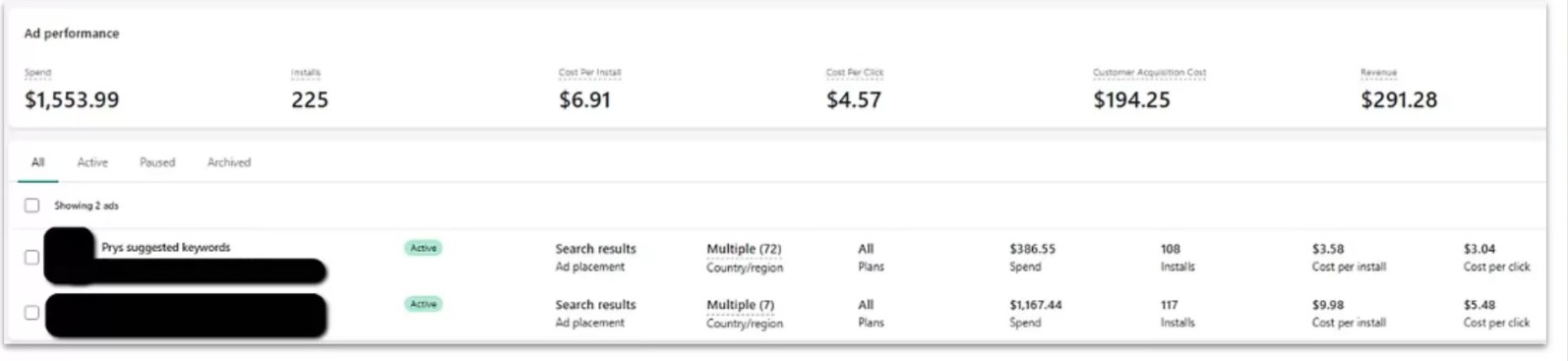
The keyword-expansion step is where the extra installs come from. In one account, the suggested-keywords campaign delivered almost as many installs as the main campaign, effectively doubling installs. In another, suggested keywords brought installs at $3.58 each vs $9.98.
See the Shopify apps we've worked with, by category.
Managed or do it yourself?
| Prys, self-serve | Convert2x, managed |
|---|
| Full funnel by keyword and geo | Yes | Yes, read for you |
| Bid suggestions and new keywords from your data | Yes | Applied for you |
| Research, account build and structure | You | Us |
| Weekly optimization, keyword expansion, reporting | You | Us |
What's included
Historical keyword research · keyword list generation with real volumes · full account structure (exact + broad, geos, devices, plans, competitors, typos, brand) · weekly search-term cleaning, negatives and value-per-keyword bids · a new-keywords campaign every two weeks · monthly reporting on installs, subscribers and revenue, not just clicks.
FAQ
We already advertise on Shopify Ads. Where do you start?
With your account's history. We analyze it for keyword performance (installs, subscribers and revenue by keyword) and for the optimal structure, then restructure the account around the keywords that pay.
Shopify Ads vs Google Ads: which first?
Most merchant searches take place in the app store. Best to cover that before moving on to Google Ads. Most clients end up running both.
How much do Shopify app store ads cost?
Beyond the $1K/mo management fee, media depends on your keywords and category. Media budgets are sized together on the first call; about $2K/mo is a typical start.
Which Shopify ads keywords actually make money?
The ones whose installs turn into subscriptions and revenue. Keyword-level attribution ties installs, subscriptions and revenue to the exact search term, and the bidding runs on that.
How do you estimate a keyword's search volume in Shopify app store ads?
From exact-match keywords only: divide impressions by visibility. Your #1 keyword often has as many searches as the rest of your top ten combined.
How much should a Shopify app bid per click?
Up to what a visitor from that keyword is worth. Visitor value is the break-even cost per click: double down on high-value keywords and lower bids on weak ones.
Exact match or broad match for Shopify app store ads?
Both, together. Exact match gives precision and control on known, high-value terms; broad match discovers new search terms. Winners get promoted from broad to exact.
Why do Shopify app store ads get more expensive?
Every app bids on the same short-tail keywords, and peak season makes it worse. Weekly negatives, value-based bids and new long-tail keywords keep the account profitable.
Own the organic results for the same keywords with Shopify app store SEO and AEO. Structure details: Shopify Ads campaign structure. Peak-season moves: BFCM for Shopify apps.